Monday, June 26, 2017

On Secession Part III: Crow and Incarceration

In this third installment of On Secession (Part I, Part II), I want to start with a focus on Sheriff David Clarke. For reasons that I hope will become obvious, we would not have this series without him. On the way, we’ll touch the prison system, Ferguson, and the ideas raised in Chris Hayes’ A Colony in a Nation. I’d also like to acknowledge the reporting of David Neiwart, as his article on Clarke is highly informative and was invaluable in shaping this series.


Black Lives Matter is a hate group. They stoke up rage. They stoke up anger in people in a misguided sort of way for a phantom grievance about the character of America’s law enforcement officers… There is no police brutality in America. We ended that back in the ’60s.
David Clarke
In the previous installment, I tried to understand and tease apart the philosophical foundation of the various Oath Keeper groups. Some of my commentariat have accused me of being unfair to their positions, but I will happily stand by my interpretation of “Natural Liberty” being fundamentally incompatible with government. In this case, Clarke’s own words back this up:
To be successful, this movement’s going to have to have two things: You have to have a common enemy, and you have to have a common language. And I’m not here to tell you what to do, or this group what to do, because as I said, I’m a Johnny-come-lately. But I know about movements. And in this movement, the common enemy – and let’s not make this mistake, because I think sometimes you do – this is not about Democrats and Republicans, this is not about liberals and conservatives. Because the ruling class in Washington, D.C., sees us as nothing more than subjects. We’re not citizens anymore, in their minds.

So don’t get caught up with liberals, Democrats, Republicans, conservatives, and even people. Obama – Obama will be gone in a couple years. But guess what will still be there, and this is the common enemy: It’s government. That’s the common enemy. It’s not Nancy Pelosi, it’s not Barack Obama, it’s not the faces and the names. These people come and go. The government remains. That’s what’s becoming oppressive, that’s what’s starting to become intrusive, more and more intrusive, and that’s what’s encroaching on our liberties.
But what’s most concerning isn’t the government he hates, but the government he likes: Policing and Prisons. But simply explaining how awful the prisons are in Clarke’s home of Milwaukee County robs us of important context: it’s not only that his prisons are especially bad (though they are), it’s that the U.S. Prison system is uniquely dysfunctional.

That the prison system in the United States is bad is not a contentious concept. While possibly not as bad as pop culture would have you believe (I wouldn’t know, as I have not had direct experience with it), the hellish nature of prison is, apparently, accepted and normalized.
Other times, the concept of prison rape is a "hilarious" punchline.
As for specifically why the prison system is so awful, I posit that it is because of the fundamental disconnect between its purpose. Namely, are they meant as places of punishment, or as places of rehabilitation?

I truly wish I could present a coherent history of the American penal system, but it’s excessively long and detailed and actively resists being cast in a single narrative. Despite this, I believe there are two critical developments that inform the shape of the modern prison system: the development of police systems during reconstruction as a means of racial enforcement in the South (post-Civil War), and Nixon’s “War on Drugs” (and the resultant rise of privatized prisons).
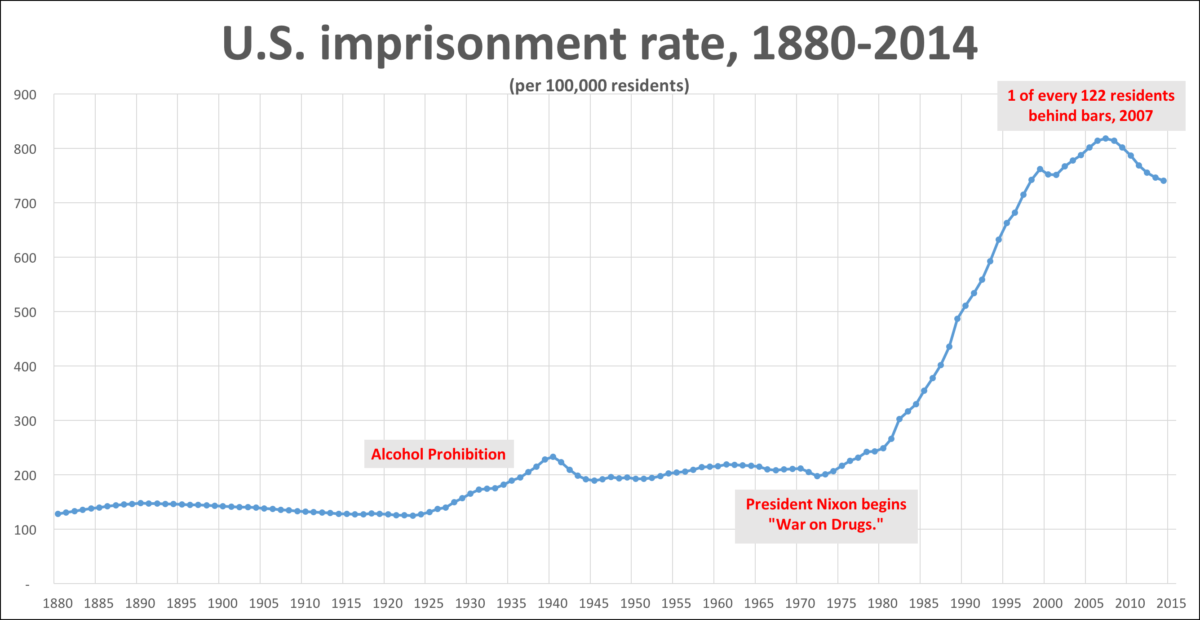
Data and Graph from The Clemency Report
It doesn’t have to be this way. Other countries have extraordinarily successful rehabilitation-based incarceration, with the express goal of giving criminals positive reinforcement in order to help re-integrate them into society as happy, productive citizens. There’s a lot of data, especially with regards to child psychology, about effective ways to reform negative behavior but I’ll one line it for you — authoritarian punishment (and specifically corporal punishment) is one of the least effective.

But as usual, it’s instructive to look at the outcome. While some degree of malice is due to incompetence, not all is. It takes a lot of dedicated work by a lot of people to keep society plugging along. For any systemic outcome, assume it is functioning as designed. Who benefits? We’ll get to that in a second, but it’s clear that the outcome of the American prison system is not to rehabilitate people; its true purpose is far more sinister.

The end of the civil war marked the end of southern society. The power structures built around slavocracy and plantations were uprooted, their society now lacking their traditional political enforcement methods. Simultaneously they, and the north, also faced a new problem: Millions of newly freed black people. While there were efforts made to help them integrate into society, such as with the Freedmen’s Bureau, the numbers made it difficult.

Of course, this in no way excuses what came next — far from it! But the scope of the change is difficult to imagine, as slaves made up about 10% of the population. Suddenly the south lost millions of workers, and the north faced an influx of low-skill workers — and suffered immediate economic repercussions as the factory owners now lacked a ready supply of cheap cotton. If America’s later responses to immigration (they took our jobs!) are any indication, the amount of political unrest generated would have been substantial. The chaos and poverty was unimaginable, especially among the newly freed slaves. As an example, 5 years after the civil war 90% of black citizens in Savannah, Georgia owned no property (and of course were excluded from all but the lowest-paid jobs). The corresponding rise in property crimes should come as no surprise, but what else were they to do? Migrating north was no answer either; it’s hard to overcome the problems of having no economic power whatsoever, not to mention the substantial discrimination faced. As for what happened next, I’ll let Wikipedia summarize:

Patterns of "mono-racial law enforcement," as Ayers refers to it, were established in Southern states almost immediately after the American Civil War. Cities that had never had police forces moved quickly to establish them,[269] and whites became far less critical of urban police forces in post-war politics, whereas in the antebellum period they had engendered major political debate.[270] Savannah, Georgia's post-war police force was made up of Confederate veterans, who patrolled the city in gray uniforms, armed with rifles, revolvers, and sabers.[270] They were led by an ex-Confederate General, Richard H. Anderson.[270] Ayers concludes that white policemen protecting white citizens became the model for law enforcement efforts across the South after the American Civil War.[270]

This was not a secret policy:

Whites made few attempts to disguise the injustice in their courts, according to historian Edward L. Ayers.[275] Blacks were uniformly excluded from juries and denied any opportunity to participate in the criminal justice process aside from being defendants.[276] Thefts by black offenders became a new focus of the Southern justice systems and began to supplant violent crimes by white offenders in court dockets. Whether they were from the city or the countryside, those accused of property crime stood the greatest chance of conviction in post-war southern courts.[277] But black defendants were convicted in the highest numbers. During the last half of the nineteenth century, three out of every five white defendants accused of property crime in Southern courts were convicted, while four out of every five black defendants were.[277] Conviction rates for whites, meanwhile, dropped substantially from antebellum levels throughout the last half of the nineteenth century.[278]
A powerful tale of injustice that resonates strongly with middle school students.
By imprisoning large numbers of black people and forcing them to work for little to no money (on chain gangs and the like), they accomplished their twin goals of removing black people from society and obtaining free labor, thus establishing slavery under another name. This was, from the perspective of the pre-guilded age plutocrats in the north and southern establishment, a real win-win situation. For the black people, not so much. By completely divorcing the justice system from the notion of rehabilitation, the prison system could be transformed into a profit-seeking enterprise.

(Also, by deliberately depriving black people from quality education, they could be kept as a low-skill labor force. This push away from teaching practical skills for the poor has had dramatic effects on the educational system in our country — as per my previous essay: Everything Wrong with College. Thus does the primary purpose of public school turn into the warehousing of children.)

Nor was this system unique to the south, as many of the northern prisons operated on a “convict lease” system, using the unpaid labor of prisoners to enrich the prison operators (notably local governmental figures). And while many limitations and protections have been placed on this over the years, it is obscenely obvious that this system and similar arrangements are continuing to this day. I’m having difficulty restraining my emotions, and bile rises to my mouth at the sight of these injustices. And if you can view these depredations impassively, then I don’t know what to say to you. While it may be legal, thanks to that important loophole in the thirteenth amendment, it is not just, and it is not good. If this is the best we can do by our citizens, our scorn is well deserved.

But I’m getting off on another emotional tangent. The stressors that led the southern prison transformation also worked inevitably in the north, as the influx of freed black people led to a self-imposed segregation (more formal segregation efforts — redlining, etc. — occurred a little later, after the first world war), as well as similar patterns of arrest and transformation for the prison system. This was especially pronounced in areas with high black population, and the history (and present day occupancy patterns) of the northern metropolitan areas clearly bears this out.

This was, with a few notable changes and reforms, the state of the prison system through the middle of the 20th century. Nixon changed that.
This is John Eherlichman, top advisor to Richard Nixon, seen here in a 1972 photograph.
I’ll let Eherlichman explain:
The Nixon campaign in 1968, and the Nixon White House after that, had two enemies: the antiwar left and black people. You understand what I’m saying? We knew we couldn’t make it illegal to be either against the war or black, but by getting the public to associate the hippies with marijuana and blacks with heroin, and then criminalizing both heavily, we could disrupt those communities. We could arrest their leaders, raid their homes, break up their meetings, and vilify them night after night on the evening news. Did we know we were lying about the drugs? Of course we did.
The consequence of this is well known, we can just look at the graph from earlier. Beginning in the 70s with Nixon (but really kicking into gear with the minimum sentencing guidelines in the 80s), the population of prisoners swelled. Until eventually, we get this:
Sources: Bureau of Justice Statistics, International Centre for Prison Studies. Chart from The Times-Piyacune.
Now this clearly isn’t the whole story. As the following table shows, even if America only jailed murderers and rapists, we would still have an incarceration rate of over 110. Some percentage of the violent criminal behavior appears to be cultural (see part I).

The focus on the experience of the American black population has a great deal to do with the overall culture and quality of law enforcement and prison in this country. Ferguson, Missouri is in many ways typical of poor towns across America. The justice system and the police’s relation towards the citizenry is as depicted in Chris Hayes’ A Colony in a Nation: adversarial and profit-driven. It’s easy to see why terms like “Fuck the Police” become normalized, the police exist to imprison, fine, and kill members of their communities. Nor is the process localized to black cities, any poor town can fall victim to this destructive pattern.

The tragedy is that, for the most part, each individual officer, judge, and sheriff are just doing as best as they can. Very few are deliberately racist, nor do they wake up trying to put people behind bars — they're truly trying to serve and protect. Yet in perpetuating the rotten system, and being victims of their own incentive structures, you end up with a prison system that is trying its best to enforce antebellum racial and class strata. The negative treatment within the prisons ferments a criminal underclass, and the high levels of recidivism are a feature, not a bug. The rise of for-profit prisons is the ultimate expression of this, with each new criminal in the system representing one more slave for their rosters.

That’s it for now. Didn’t have time to get into the horrific situation within Clarke’s Milwaukee county jail like I intended, but we’ll get to it next week.


Monday, June 19, 2017

On Secession Part II: Henry and Violence

In part I of this series, my desire to figure out why Sheriff David Clarke and the Oath Keepers believe the things they believe was hampered by the fact that there is an enormous amount of history to account for. Thus, we began a historical accounting of American ideologies and cultures (as per David Fincher’s Albion’s Seed). Left hanging were the questions of whether or not the South was morally or legally justified in secession, and whether states or individuals should have rights that supersede the federal government.


Why do we have a Second Amendment? It's not to shoot deer. It's to shoot at the government when it becomes tyrannical!
Senator Rand Paul

David Clarke saluting the crowd at the RNC, without his trademark sheriff’s hat.

Now that we’ve covered some of the history, who the heck is this guy?

Don’t worry if you haven’t heard of him before, I hadn’t either. He’s been Sheriff of Milwaukee County in Wisconsin since 2002 and started his career in the Milwaukee Police Department in 1978. He’s got a wife, a horse named Rodger, and is a registered Democrat.

But he’s also been a speaker at the Republican National Convention and at CPAC, a guest on Alex Jones’ radio show, as well as frequently appearing on various Fox News programs, so we’re going to need to dig a little deeper.

Understanding David Clarke means understanding his ties to the Oath Keepers. On June 13th, 2016, he received a “Leadership Award” from the New York Oath Keepers, and gave a 35-minute speech. He is not a formal member of their “militia” but, for context, here is the Oath Keepers list of “Orders We Will Not Obey”:

1. We will NOT obey orders to disarm the American people.

2. We will NOT obey orders to conduct warrantless searches of the American people.

3. We will NOT obey orders to detain American citizens as “unlawful enemy combatants” or to subject them to military tribunal.

4. We will NOT obey orders to impose martial law or a “state of emergency” on a state.

5. We will NOT obey orders to invade and subjugate any state that asserts its sovereignty.

6. We will NOT obey any order to blockade American cities, thus turning them into giant concentration camps.

7. We will NOT obey any order to force American citizens into any form of detention camps under any pretext.

8. We will NOT obey orders to assist or support the use of any foreign troops on U.S. soil against the American people to “keep the peace” or to “maintain control."

9. We will NOT obey any orders to confiscate the property of the American people, including food and other essential supplies.

10. We will NOT obey any orders which infringe on the right of the people to free speech, to peaceably assemble, and to petition their government for a redress of grievances.

With a list like this, you might think that this was an organization dedicated to ensuring lawful behavior among America’s civil servants, albeit one with a maniacal obsession with gun rights. In this, unfortunately, you would be wrong. There’s significant ideological (and membership) overlap between the Oath Keepers, the Sovereign Citizen Movement, and the Constitutional Sheriffs and Peace Officers Association (CSPOA), of which Sheriff Clarke is a member. Here is a quote from the CSPOA’s “Statement of Positions”:
America needs to make a strong turn around to get back on the freedom track laid for us by our Founders.  We believe it can’t be done from the top down, due to many factors, not the least of which is corruption and entrenched bureaucracies in high places.  We must, and we can, accomplish this turn- around starting locally at the county level, and lower.  The office of county sheriff is the last hope of making this happen, and we are witnessing great deeds of protection, service, and interposition across America by courageous sheriffs who only want to serve the people who elected them.
It’s a lot to unpack. I’m going to attempt to read through the lines, by referring back to the values of the 4 main American cultural traditions (Puritan, Quaker, Cavalier, and Borderer) and their different views on liberty that we established in part I.

To refresh, they are (in order):
  • Reciprocal Liberty: The right of each person to demand all liberties they would extend to others (aka the Golden Rule).
  • Natural Liberty: Liberties are innate, and it is the right of people to (violently) defend them.
No, it’s not “Whoever has the Gold makes the Rules”.
But what is that “freedom track”? I'm not sure, but I think I have an example that comes close to what the CSPOA means: The doctrine espoused by Patrick Henry, as he argued the Parson’s Cause.
An 1834 painting, depicting the 1763 case. It’s not very good.
The exact words used were not recorded, but the case itself, and the arguments used, became notorious. Our most accurate rendition comes from a letter penned by one of his courtroom opponents, describing the events to another Parson. I have (heavily) edited it, mainly for brevity:
That a King, by annulling or disallowing [this law], degenerates into a Tyrant, and forfeits all right to his subjects' obedience… The only use of an Established Church and Clergy in society, is to enforce obedience to civil sanctions, and [other] duties of imperfect obligation; that, when a Clergy ceases to answer these ends, the community have no further need of their ministry…the Clergy of Virginia… [should therefore] be considered as enemies of the community; and …punished with signal severity. [The Jury must] rivet their chains of bondage… [and] dispute the validity of [any] laws, [not] authenticated by the… authority of a legal representative of a Council, and of a kind and benevolent and patriot Governor.
The details of the case are less important than the fact of Henry’s (successful) argument: an act of government that opposes the stated will of the people renders that government tyrannical and superfluous.

Later, as the colonies moved toward revolution, Henry went on to denounce strong government in any form, and vowed to fight against it (“Give me Liberty, or Give me Death!”). That the liberty he demanded was “natural liberty” is obvious, but interestingly, this appears to be the main type of liberty that the Oath Keeper groups are concerned with. The “courageous sheriffs who only want to serve the people who elected them” are dead ringers for the “kind and benevolent and patriot Governor” insisted upon by Henry.

And this is where I run out of cleanly packaged information and start asking questions. Questions like: Is the concept of Natural Liberty consistent and actionable? Is it justified? And most importantly, can it be reasonably implemented in the 21st century?

(Note: I know I’m avoiding the Confederacy’s argument, but I think the Natural Liberty argument is both stronger and more relevant. I’m trying to answer a more general form of the question, but I’ll come back to them later — they’re not off the hook yet.)

As someone who strongly backs the Quaker concept, I’m struggling to make sense of the Borderers. Namely, I’m trying to make sense of the end game. This question can be more narrowly posed to the groups from earlier, but what does society look like if you get everything you want? I mean, I understand the Quaker end game, a quasi-socialist utopia where everyone is nice, kind, and respectful to one another, but I do not understand where Borderers are trying to go. My biggest question is: where does it end?

I’m going to try for a thought experiment. Let’s say we have this group of people, they don’t like their current government. Could be that it’s infringing on their natural liberties, or it could be that they don’t have control, whatever. They gather themselves together (with guns) and demand the ability to form their own government, the way they want. There’s a bit of violence, but they win and now there’s two governments, one in the north and one in the south.
Pop culture references are very popular.
Ok, great. But now some of the people who rebelled (the Karstarks and the Boltons??) don’t like the new government they made, and want to make their own government. And so on and so forth. I’m struggling to come up with a coherent system of Natural Liberty that allows you to demand liberty on pain of violence, that doesn’t immediately threaten to unmake any systems you’d try to put in place. If violence is political power, and assuming everyone has nearly equal abilities in that regard, doesn’t it just eventually end with every man for himself? Or with a bunch of warring clans jostling for territory or vengeance for some perceived slight? (ref: the history of family feuds in America)

I know the idea of a man who doesn’t answer to any law but his own, a sheriff trying to do good as he sees it — it’s appealing. We’ve seen characters like this in countless films and stories. But, and I fully admit this is the most boring answer possible, it just doesn’t seem practical. I mean, yes. I like rights, I like freedom. But two things seem readily apparent: 1. Some amount of government is needed to prevent tribal barbarism. And 2. Part of that government’s responsibility is to maintain a monopoly on violence.

This is a point where I imagine I will lose some of my readers. Gun control is a contentious issue, and I will make no attempt to adequately cover it. But to sidestep the issue of “self-defense”, my question is: to what degree are individuals empowered to take the law into their own hands? Again, any explanation I could give would be insufficient, but it seems to me that society is maximally stable if individuals are not able to self-adjudicate. I say this because any two random people will likely disagree on issues, but if they are enforcing their opinions with violence, they cannot mutually exist in the same society.

For an unnecessarily provocative example, say you believe in the right to defend yourself (and others) from people who would cause them harm. This is a common belief, so it shouldn’t be too hard. But say you also believe that fetuses are people from the moment of conception. In this case, killing abortion doctors (to stop abortions) would be justified. And, in the implied corollary, the doctors (and anyone nearby) would have the right to kill you too (in justified self-defense). A single intense disagreement could snowball into an actual war, or at least a violent feud.

Now, I won’t eliminate the possibility that I’m being incredibly dense, but I just don’t see a way to reconcile “having a stable society of laws” with “the right to self-determine what those laws are”. It seems that the “cost” of existing in society includes a necessary abdication of choice.

And if society is good, this is a good thing. Certainly, the Puritans/Quakers would happily cede their choices if they could trust their society to be just and good. Indeed, as with the modern-day Democrats, making sure the government as good, wise, just, and strong becomes a moral imperative, since leaving people to their own devices means inevitable strife and anarchy. A more glowing recommendation of the status quo can scarcely be imagined.

Obviously, the world is not so optimized a place, and insisting on abstention from self-defense is the most untenable argument I’ve backed in a long time. Clearly, in the balance between order and chaos, it’s difficult to not cede territory to chaos. This is a contradiction that (I assume) David Clarke would declare solved.

This stock image is very literal.
Re-reading the CSPOA’s statement in this light, they seem to be upholding the value of natural liberty, and declaring the smallest discrete amount of tolerable government: a county sheriff. Convenient then, that it’s an organization of sheriffs. It’s difficult to see this as any more than an intent on government via individual fiat. No doubt that the courage and nobility of the county sheriffs will make disagreements impossible; each sheriff keeping to the constitution, ruling over their flocks with a wise and gentle hand. You’ll have to excuse my skepticism, especially considering Clarke’s malfeasance, which will be one of the primary subjects of next week’s post. We’ll just put a pin in that for now, because we’re out of time for today.

In answering our questions, I think we’ve made a bit of progress. We’ve identified a bit of what and why Clarke and the rest of the Oath Keepers believe what they believe, and explored whether individuals should have rights that supersede the federal government. But we’ve still got a way to go before making our definitive case for or against secession, and in determining the optimal rights of states. Also, left hanging is the unstated question of what all this means to us now. Until next time.

Monday, June 12, 2017

On Secession Part I: Settling and Confederacy

The recent removal of confederate monuments in New Orleans had me in the mood to write yet another emotionally affected hit piece — But it turns out that American history is complicated. Who knew, right? I originally started with research into the Oath Keepers and Sheriff David Clarke, but we’re not going to get to him yet. Consider this part I of a new series.

The Civil War, if you think about it, why? People don’t ask the question, but why was there the Civil War? Why could that one not have been worked out?
Donald Trump 

For me, one of the more interesting aspects of history is that ideologies rarely die. Ideas and cultures can be traced back centuries, and once-settled vendettas can return with a vengeance decades (or centuries) later. And, since everything is connected to everything else, context is everything.

I say this, because these are ideals with old, old roots. To tell the story properly, we have to go back to David Fischer’s Albion’s Seed and the founding of America, and we have to answer a question that I thought well settled: “Was the South morally or legally justified in their secessionist movement?” Additionally, we must answer the modern-day question of whether or not states (or individuals) should have rights that supersede those of the federal government, and if so, what are those rights?

Let’s get one thing out of the way: America was never unified. Instead, each region formed based on different distinct waves of English immigration/colonization. Over the 946 pages of his book, Fischer identifies the 4 groups who have had the largest influence on America.

1.     The Puritans, who settled from East Anglia in the 1620s. Their culture, in addition to being highly religious and puritanical, also dedicated to education and civic service. Their Calvinist philosophy was highly influential in shaping the Northeast.

2.     The Cavaliers, refugee nobles from the south of England, fled to Virginia in the 1640s following the English Civil War. Being nobles, they did not like to work, and brought thousands of indentured servants with them, eventually moving to imported African slaves. Their plantation model and their peculiar ideals shaped the south (more on this in a bit).

3.   The Quakers, a religious group believing in pacifism, tolerance, equal rights, and ethical capitalism, settled in the area now called Pennsylvania (named after William Penn) in the late 1670s. The Quaker influence on America was broad; there’s a reason the Continental Congress was in Philadelphia.

4.     The Borderers, a large group from Northern England, who were... fiercely independent, straight-talking, and prone to violence. They settled in Appalachia and formed the base of America’s western expansion. Borderer tradition was what made the “wild west” wild.


Though America is more mixed these days, group influence can still be plainly observed, as in the following map:
Obama in green, Clinton in red
This alignment between Borderer regions and Clinton victories is unlikely to be a coincidence.

But I’m getting ahead of myself. The point is, the United States were born divided. 13 independent colonies, imperfectly coming together. It was not a harmonious union and many of the compromises (such as the famous “3/5ths Compromise”) were designed to give the agrarian slave-holding states greater political influence and representation. And, as is the nature of compromise, both sides were left unhappy. Benjamin Franklin summed up the mood well: “I confess that There are several parts of this Constitution which I do not at present approve, but I am not sure I shall never approve them. ... I doubt too whether any other Convention we can obtain, may be able to make a better Constitution”.

Obviously, this didn’t last. Abraham Lincoln’s election triggered a wave of secession, as he was elected without the votes of a single southern state. Worried that the northern states might vote to eliminate chattel slavery, and enraged at the northern states’ unwillingness to sufficiently enforce the Fugitive Slave Act — a position simultaneously pro and anti-state rights — the southern states left the Union.

The Civil War, I’m assuming, is history everyone is familiar with. Lincoln refused to recognize the Confederate government, or the legality of their secession, and when Confederate troops fired on Fort Sumter the war began in earnest. Note: the concept of the “War of Northern Aggression” rests on historical revisionism (read: lies). The Southern states were explicitly clear that their reason for seceding was about slavery. Regardless, the war was very bloody, and very personal. Both the North and the South instituted a draft, and the drafts could be avoided with money in the North, and sufficient slave ownership in the South. Thus, the war was fought between poor whites on both sides, each fighting for the interests of their respective elites.

The war ended only when Union forces did enough damage that war was impossible, though it did continue afterwards in small pockets (the main bulk of the Southern army surrendered with Robert E. Lee at Appomattox). Eventually, the slaves were freed, the states readmitted to the union, and then the South won.

That’s a deliberately provocative statement, but the history holds up. The South may have surrendered, but only out of necessity. The period of Reconstruction was essentially an occupation, preventing the southern states from expressing their right to enslave and oppress black people. And, like any occupied country, they enjoyed many lively insurgencies which rebelled violently against the occupying force, fighting to restore the traditional government wherever possible (this was the first incarnation of the Ku Klux Klan). Not so coincidentally, this was also the beginning of the southern states inordinate focus on — and hatred toward — taxation. This will be an important detail later.
This is clearly just a bunch of patriots and good old boys. Nothing to see here.

So how did the South win? 

Short answer: The rebellion used political violence, terrorism, and murder until the Northerners gave up and left the South to its own devices. Which meant rigging elections, lynching, and the reinstatement of slavery via sharecropping, imprisonment, and other means.

 Long answer: The short answer plus the fact that the radical Republicans/Abolitionists wanted to set up an equal-ish society in the south. This meant giving the newly freed slaves land, education, and other things, expensive things that were necessary to keep the ex-slaves self-sufficient and not subservient. 

This approach ran into problems immediately, as the more conservative Republicans balked at the expense (and of course, being nice to ex-slaves by giving them economic and political power made the South madder than a cat in a bathtub). Enforcing this required enormous manpower and occupying troops, some of whom were killed by the people in the above photo. Eventually, the rich elites in the North realized that it didn’t really matter who picked the cotton or how, as long as it got picked and delivered on time. So, with the Compromise of 1877, a Republican landed in the white house on the condition that Reconstruction was finished, and leaving the South free to govern themselves as they liked.

Thus, the South won against the North, and their systems of legal enslavement persisted until the civil rights era, after which everyone was free and no one was ever unjustly enslaved, imprisoned, or disenfranchised again. The cost of peacefully restoring the Union was, apparently, to let the rebels enslave and oppress the blacks.

And for a while, things were relatively ok, at least by comparison. The country governed itself, political violence was common but did not result in open warfare, other new immigrant groups arrived and were subsequently oppressed, and America was at peace with itself. But the peace, now as in the past, remains fragile and conditional.

This has modern-day implications, but first, let’s go back to our 4 groups from earlier and see what they’ve been up to for the last few hundred years. Obviously, at this point these 4 are not the only immigrant groups, but Fischer makes a strong case for their continuing influence in shaping America’s culture and history. Our other immigration groups (such as the New York Dutch, the French Louisianans, Caribbean Blacks, and so on) have largely assimilated into nearby dominant cultures. So, what happened to all of them? Well, they’re us. This is somewhat speculative, but the influences can be tracked.

The Puritans believed in a mixed government that was democratic but protected aristocracy. Their focus on education gave them influence within the rapidly growing American elite, and American universities remain heavily influenced by Puritan ideals. Throughout history, they have favored active government and social equality. Their notion of liberty is collective: the right to make laws to order society, protecting people from basic want. Politically, they have been Whigs, Federalists, classic Republicans, and modern-day Democrats.

The Quakers have faded into the background culture; these days, the number of actual practicing Quakers is low. Their egalitarian spirit put them on the forefront of civil rights advocacy numerous times in American history, most notably as Abolitionists (many of the underground railroad operators were Quaker), and in the fight for women’s suffrage (Susan B. Anthony was a Quaker). Their notion of liberty was reciprocal, whereby each person is entitled to self-determination and freedom of conscience.

Today, the Quaker and Puritan traditions seem to form the base of the “blue” tribe in American politics, and their states they settled in are still significantly “bluer” than the rest of the country.

The Cavaliers favored a strong, traditionalist, and deeply conservative society — with minimal government oversight. Few laws, but strict adherence to social norms. As befitting their noble tradition, they organized their society with what Fischer terms as “hegemonic liberty”: the freedom to rule and not be ruled in turn. This took its historical shape most keenly during the slaveholding era, during which the South was ruled via slavocracy. In this society, a strict hierarchy was maintained, with liberty for each according to his station. The right of the few to achieve enormous freedom is preserved at the expense of liberty for many. For the owners, unlimited liberty, for the poor some, for the indentured servants less, and for the slaves none at all. The existence of slaves was, ironically, a stabilizing effect on southern society, as even the most oppressed whites had someone to look down on.

These days, hegemonic liberty has been toned down, and made much less obvious. Cavalier ideas survive in the modern libertarian movement, and the arguments are clearly seen once you start looking for them. When a man who makes more money in an hour than his workers do in a month complains that his freedom is being impacted by burdensome governmental regulations, he is arguing for the freedom to rule — to be able to act without being ruled by the will of others. Politically, this tends to find a home in the leaders of the modern-day Republican party, though of course there are plutocrats on both sides of the aisle.
A 1930s propaganda piece

Last, but certainly not least are the Borderers. The settlers of the hills of Appalachia have been maligned for hundreds of years. Hillbilly, redneck, white trash — even today Borderers are seen as acceptable targets for ridicule. But despite this, Borderer culture has had an outsized influence on America. If one was to sum up the Borderer ethos in a single word, that word would be “independent”. Their conception of freedom was based on “natural liberty”: freedom to do as you wish, without the constraints of law or custom. Autonomy from institutions and personal sovereignty are prioritized above all else. In practice, this often meant that Borderer culture was structured around retaliation and retribution over slights, with longstanding feuds only broken by outside interference or by individuals charismatic enough to unite the warring clans.

The Borderer desire for personal autonomy forced America’s westward expansion, as their search for space and isolation kept them and their descendants on the frontier, for as long as there has been a frontier. Enormous swaths of America were settled by Borderers, particularly in the southwest. Our map from earlier shows the downward migration of Borderers from western Pennsylvania and Ohio, south through Kentucky and Tennessee, and west through Texas, New Mexico, and Arizona. The “country-western” accent is a strong indicator, mirroring the accent of the original settlers (as well as their similarity to the 1700s cultural norms of poor education, gun culture, violence, xenophobia, high premarital pregnancy rate, militarism, and patriotism).
John Wayne: Borderer Hero
Borderers tend to be relatively apolitical; their interests are self-interests, not policy. As such, they have formed the bulk of every populist movement in American history — Including Andrew Jackson, most folk heroes, Theodore Roosevelt, William Jennings Bryan, the labor movement, and the Tea Party (culminating in the election of our current president). That the modern-day republican party was brought low by a man who appealed to Borderers but was indifferent to the party’s libertine/libertarian agenda should not have been a surprise to the “Never-Trumpers”. For the remnants of the Cavaliers to control the country, the cooperation of the Borderers is a must. And they do, witness the anger from the Trump supporters as the machinery of government and “deep state” defies their wishes at every turn. For a shorthanded approximation, however, we can label the “red” tribe of modern American politics to be composed of Cavaliers and Borderers.

(Obviously, this is an extraordinarily biased perspective; I can’t not pretend to have moral and political biases. There are certainly other interpretations, and other ways to delineate the various groups. But I hope that I’ve accurately described the facts, as well as beliefs of each group. If not, hopefully someone will let me know, so I can fix it. There’s more than enough for everyone to disagree with, even with the same facts.)

As for the question of whether the South was morally or legally justified in their secessionist movement, and whether states (or individuals) should have rights that supersede the federal government, the modern-day implications over the failure of reconstruction, and a look at modern rebel “patriots”, will have to wait for another time.

Continued in Part II.

Monday, June 5, 2017

On Resignation


I’m kind of harping on this A.I. thing, but I read an article that helped put my Neuralink post (On the Connections Between Brains and Computers) in perspective — and not in a good way. The self-selected summary is as follows:
  1. Artificial Intelligence cannot be stopped.
  2. Initiatives (cl)aiming to "stop AI" will either fail to slow or actively hasten it.
  3. Attempting to subtly influence the development of AI is a waste of time.
  4. Other people have already figured out 1, 2, & 3 and [have] chosen not to tell anyone.
Obviously, not everyone in the field is as concerned with destructive A.I. scenarios, but this isn’t the place to split hairs; a wise man cautioned us to “avoid world-ending assumptions”. While the reasoning flies a bit closer to Pascal’s wager, then I’d prefer, it’s still good advice. Many of the optimistic assumptions and predictions about A.I. are the kind of assumption that if it’s wrong (or wrong in the right sort of way), that’s it. Near-instant extinction for planet earth.
Or at least death to Sarah Connor

It’s an embarrassing lapse, but I did not think much about how the very people who already know all the stuff I’m learning would behave. I wasn’t thinking enough steps ahead. Seen in this context, Neuralink isn’t an exciting new tech venture so much as a desperate hope to mitigate an unavoidable disaster.
 
I don’t really have anywhere fancy I’m going with this, but controlling A.I. is extremely difficult. They are, in many ways, faster, smarter, and more resourceful than we are, and the disparity will only grow with time. Even the simple A.I. we have now are more than capable of surprising their creators with unforeseen loopholes and undesirable outcomes (like the Tetris-playing A.I. that paused the game in order to not lose). Adding to this complication is the fact that neural networks learn in ways that are difficult to track. They’re complicated. Not as complicated as brains, but they're still black boxes — not even the people operating Alpha-Go know exactly how it decides on the strategies it uses. 

This is fine for Go, but less fine when A.I. is running everything in society. Much like editing, it is nearly impossible to find every mistake. Humans are imperfect; there is a crack in everything. We’re still quite a ways off from an Artificial General Intelligence, but humans are error-prone. Eventually, someone will slip up, and if it’s bad enough, that’s it (again). We've already outsourced prison sentencing to A.I. and the fact that these systems are likely to make better predictions than the people doesn't mean there aren't unaccountable errors. While the first errors are likely going to be more benign (potentially unjust prison sentencing), the later ones will be far worse.

But circling back to number 4, this isn’t conjecture. For instance, Elon Musk has stated publicly that the existential threat from A.I. is one of the main motivators for SpaceX. Likewise, Neuralink is an awful, awkward, messy fix to the problem of A.I., but it’s at least theoretically sound. In this case, capitulation, resignation, and surrender look like spending a billion dollars to computerize our brains before the computers don’t need us anymore.

Postscript: I don’t want this to be interpreted as a ringing endorsement of Mr. Musk, he is certainly a man with many faults (as is readily evidenced by SpaceX’s labor lawsuits). Certainly, some of Silicon Valley’s more reprehensible practices are hard to justify, though I imagine it’s easier to sleep at night if you imagine yourself as working tirelessly to save humanity (Another checkmark in his favor is his recent resignation from Trump’s advisory council, since Trump’s withdrawal from the Paris accord made it clear that there’s no point trying to steer that ship).

Edit: Added a few more links. Also of note: optimism towards the future of AI seems to be limited to non-experts.